The Diocese of Winona closed the year of faith with a series of deanery based celebrations. The area parishes gathered in a single place for prayer, reflection and a message from our Bishop. I was in Owatonna and it was a great celebration with around 350 people in attendance. Our young people were on for greeting and helping serve the dinner. They did a great job.
In his video, Bishop Quinn highlighted that in September, 2014 we will celebrate the 125th anniversary of the founding of our diocese in 1889. He spoke of the coming year as a year of thanksgiving - for faith and for the local communities that have nurtured the faith in the past and will continue to do so into the future.
Thursday, October 31, 2013

Tuesday, October 22, 2013
The Board of Directors of the FDLC with Archbishop Marini
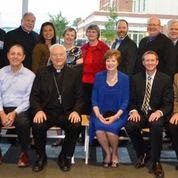

Press Release on the National Meeting of Diocesan Liturgical Commissions
LITURGISTS FROM ACROSS THE USA GATHER TO REFLECT ON
FIFTY YEARS OF THE CONSTITUTION ON THE SACRED LITURGY
Truly, "the liturgical renewal is the most visible fruit of the entire work of the Council." So spoke Archbishop Piero Marini as he addressed the participants at the annual meeting of the Federation of Diocesan Liturgical Commissions. Archbishop Marini, President of the Pontifical Committee for International Eucharistic Congresses and Master of Pontifical Liturgical Celebrations for Blessed Pope John Paul II and Pope Emeritus Benedict XVI, was actually quoting the 1985 Extraordinary Synod of Bishops.
First, Archbishop Marini set the Second Vatican Council in its historical context providing background on the decades that led up to the Council. He noted that it was the first Council to be a truly universal council, not simply European nor regional. Moreover, it was rightfully called a pastoral council -- unique in that this was called to address Church issues, not to react to a crisis of thought from outside entities. This fact, he assessed, tends not to lessen, but to increase, the weight of conciliar decisions.
Drawing on the writings of Blessed john XXIII, Archbishop Marini offered theological reflection on the nature of councils. "Precisely in her Councils, the Church both celebrates Christ’s union with herself and points to the presence of Christ in history. Historical events must therefore, in some sense, be interpreted by believers as a new manifestation of the incarnation: the signs of the times are signs of the continuing presence of the risen Christ in history, through his Spirit."
Certainly, this year the Church is celebrating the fiftieth anniversary of the adoption of the
Constitution on the Sacred Liturgy (12-4-1963). But Archbishop Marini also asked the participants to look ahead. "The reform has proved faithful to the will of the Council Fathers and the basic principles on which it was built are enduring. Its concrete implementation, however, could not and cannot ever be perfect or complete. The Council is not behind us; it still precedes us."
Archbishop Marini was one of several scholars who were asked to speak on the meeting’s theme: "The Christian Mystery and the Enduring Value of
Sacrosanctum Concilium." Other Study Day presenters included Archbishop Samuel Aquila of Denver who reflected on the history of Confirmation as a sacrament of initiation. He offered an historical overview of the sacrament from the Acts of the Apostles to our present age. He drew on his experience of restoring the order of the sacraments of initiation in his former Diocese of Fargo.
Alluding to Pope Benedict XVI’s words in
Sacramentum Caritatis, Archbishop Aquila noted that this practice "better enables the faithful to put the sacrament of the Eucharist at the center, as the goal of the whole process of initiation."
Further, Archbishop Aquila noted that "Confirmation is anticipated by Baptism, but the full strength and mission given by the Holy Spirit is lacking without Confirmation… The gift of the Holy Spirit given in Confirmation is ordered to the life of worship. St. Thomas Aquinas affirms that the seal given in Confirmation qualifies the Christian to participate in worship..."
Sr. Dianne Bergant, CSA, noted Scripture scholar and professor at the Catholic Theological Union in Chicago, emphasized how the
Constitution affirmed the role of Sacred Scripture in the life of the Church and set it as an integral part of all liturgical celebrations.
The Council called for an increased use of Sacred Scripture and a renewed appreciation of the Bible using the methodology of historical criticism. One must appreciate the genre of the text, the culture of the times, and for whom it was written. A preacher, then, Sr. Bergant noted, has to examine the text in all its dimensions – the word that the text creates, the world that the author creates, and the world of the hearing assembly. "The story of the Bible is that God remains faithful."
The meeting was held in the beautiful city of Erie, Pennsylvania. Emeritus Bishop Donald Trautman addressed parish liturgical ministers and spoke on the four pillars of Vatican II -- the
Constitution on the Sacred Liturgy, The Constitution on the Church, the Constitution on Divine Revelation, and the Constitution on the Church in the Modern World. He outlined the contributions of each to modern theological understanding and pastoral practice.
He noted that the phrase ‘the People of God" was used 140 times in the Council documents. He thanked the liturgical ministers for their role in the authentic and reverent celebration of the Church’s liturgies.
THE 2013 McMANUS AWARD
On Friday, October 11, the Federation awarded its prestigious Frederick R. McManus Award to Father Paul Turner. Father Turner is a priest of the Diocese of Kansas City -St. Joseph and a noted scholar on the liturgy. He is past president of the North American Academy of Liturgy and a prolific writer of books and articles. This award particularly recognized his outstanding contributions to dioceses, presbyterates, and parishes, as they prepared for the new English translation of the third edition of the Roman Missal.
He accepted the award in his usual humble and eloquent fashion -- "I’m the wrong guy," he quipped. But he also encouraged the assembly to listen to God’s call. "Other people might know you better than you do. Always, God knows you better than you do…. You may not know what all your gifts are. But when you figure them out, you’ll also realize that you got them for a reason. You got those gifts because you are the right person. Give them back for the glory of God."
ABOUT THE MEETING
The meeting was co-sponsored by the Federation of Diocesan Liturgical Commissions and the Bishops’ Committee on Divine Worship of the USCCB. Archbishop Gregory Aymond, current chair of the BCDW, and his staff provided updates on the upcoming translations of liturgical rites and the status of those texts which the Bishops have already approved.
On Tuesday, October 8, Msgr. John Burton, Chair of the Board of Directors, officially welcomed the FDLC’s new Executive Director, Mrs. Rita Thiron. She is the former Director of the Office of Worship for the Diocese of Lansing, Michigan. Throughout the course of the week, members heard reports and participated in enthusiastic discussions regarding the future of the Federation.
The meeting was graciously hosted by Bishop Lawrence Persico of the Diocese of Erie and the dioceses of Pennsylvania and New Jersey.
The Federation of Diocesan Liturgical Commissions was founded in 1969 by the United States Bishops as a vital network for sharing the vision of the Council and for teaching about the revised liturgical books.
Tuesday, August 27, 2013
Catechetical Day
Yesterday was our diocesan catechetical day. We are in a series of formation days around the faith with our catechetical leaders and the topic yesterday was Sacraments. I gave a presentation on preparing to celebrate Mass with children in schools and faith formation programs.
In her book, Preparing Parish Liturgies: A Guide to Resources (Liturgical Press) Rita Thiron has a list of "Ten Basic Principals of Liturgical Preparation" that I used as a kind of summary of my talk. They are:
I also proposed planning "from the inside out.' By this I mean starting with Sing to the Lord being intentional about planning acclamations, dialogues, etc. rather than trying to figure out what our favorite song is and how we will find a place for it.
I hope the folks took some good principals with them from the very hot room, non-airconditioned room.
We began with Mass and used one of the Michel Guimont/Delores Dufner pieces from Amen to the Body of Christ - Bread of Life, Cup of Blessing.
In her book, Preparing Parish Liturgies: A Guide to Resources (Liturgical Press) Rita Thiron has a list of "Ten Basic Principals of Liturgical Preparation" that I used as a kind of summary of my talk. They are:
- It's all about the paschal mystery!
- Every liturgy is the function of the priestly office of Jesus Christ
- Recognize the role of the assembly
- lex orandi, lex credendi
- Always begin with the rite
- The Word is essential
- Allow the ritual to speak
- Environment affects worship
- Music is integral
- Preparation and evaluation is imperative
I also proposed planning "from the inside out.' By this I mean starting with Sing to the Lord being intentional about planning acclamations, dialogues, etc. rather than trying to figure out what our favorite song is and how we will find a place for it.
I hope the folks took some good principals with them from the very hot room, non-airconditioned room.
We began with Mass and used one of the Michel Guimont/Delores Dufner pieces from Amen to the Body of Christ - Bread of Life, Cup of Blessing.
Wednesday, August 21, 2013
Diocese of Winona Harvest Mass

On August 15, the Solemnity of the Assumption of the Blessed Virgin Mary the Diocese hosts a "Harvest Mass" on one of the farms in the Diocese. The local committee works very hard in welcoming almost 500 people to the event. This year the Mass was near East Chain, MN.
Thursday, August 15, 2013
The Solemnity of the Assumption of the Blessed Virgin Mary
 Happy Feast Day! Today we celebrate Mary's Assumption, body and soul into heaven. In establishing this feast Pope Pius XII declared: "By the authority of our Lord Jesus Christ, of the Blessed Apostles Peter and Paul, and by our own authority, we pronounce, declare, and define it to be a divinely revealed dogma: that the Immaculate Mother of God, the ever Virgin Mary, having completed the course of her earthly life, was assumed body and soul into heavenly glory."
There are many wonderful representations of this event. It has inspired artists of every age. One of my favorite depictions has the disciples gathered around the tomb of Mary which is filled with flowers. Often their faces show their consternation. Above, Mary is shown being taken up to heaven. I love how it unites the earthly and the heavenly in Mary.
In preparing for my homily I reflected on Deacon Greg Kandra's reprinted homily on The Deacon's Bench. In it he tells of a journal entry by Henri Nouwen in which a priest that he has met describes Mary's meaning for the world, “To look at Mary is to see God’s original plan for humanity.” Both in her life and in her Assumption Mary reveals to us what God desires for us.
Wednesday, August 14, 2013
The Feast of Maximilian Kolbe
 I have had, for many years, a special affinity for St. Maximilian Kolbe. It results from having had the opportunity to be a part of the "guide choir" at his canonization. This is the choir that sings the people's part of the Mass at large Vatican liturgies. I don't know if this practice is still in place but it was in the 1980's when I was in seminary.
One of my profound memories of the day is the figure of the man for whom St. Maximilian Kolbe gave his life. Here is a link to his story and a picture of the St. Maxmilian and Franciszek Gajowniczek.
http://nealobstat.wordpress.com/2013/08/14/16670/
Subscribe to:
Posts (Atom)